
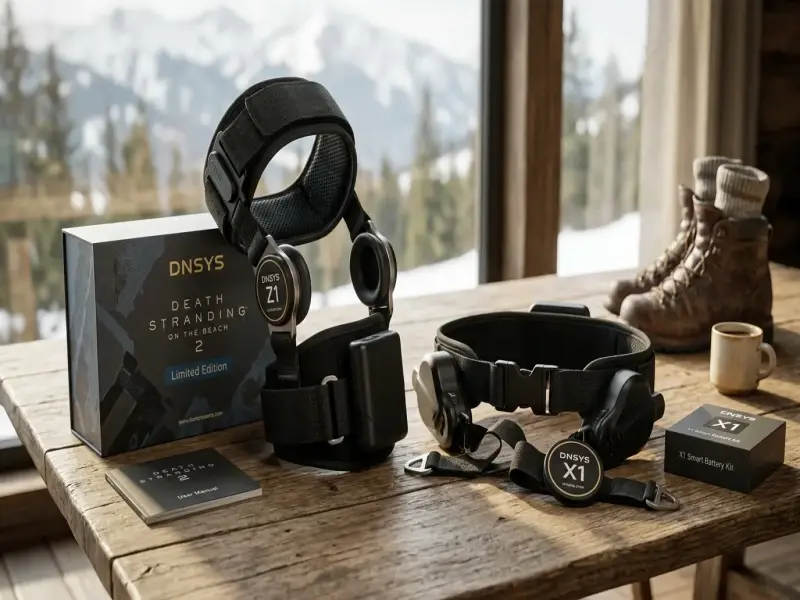
DNSYS develops wearable powered exoskeletons designed to assist movement across hiking running cycling skiing sports and everyday activities. Its main products are the hip focused X1 and the knee focused Z1.

The wider DNSYS collection includes dedicated
batteries straps knee care accessories a smart belt and a limited edition Z1
created in collaboration with Death Stranding 2.
Introduction
Wearable robotics has moved beyond laboratories and
industrial environments. Products such as powered exoskeletons are increasingly
being designed for outdoor recreation fitness and everyday movement. DNSYS is one of the brands working in this
space with a product range centered on lightweight lower body assistance.
The company focuses primarily on two wearable systems. The DNSYS X1 is a hip joint exoskeleton
designed around walking speed endurance and lower body assistance. The DNSYS Z1 is a knee joint exoskeleton
designed around climbing stairs slopes and activities where the knees
experience significant load.
The appeal of the category is straightforward. A wearable
exoskeleton can provide powered assistance while allowing the user to remain in
control of normal movement. Instead of replacing human movement the device is
intended to work alongside it.
DNSYS also offers
accessories that support the main systems. These include batteries straps knee
care equipment and a smart belt. The company has also introduced a special Z1
edition connected with Death Stranding 2.
This guide examines the DNSYS product range in detail. It looks at
design functionality construction practical applications and the differences
between the X1 and Z1 without treating either product as a substitute for
medical rehabilitation equipment.
Understanding the DNSYS Product Range
The current DNSYS store is organized around the X1
collection the Z1 collection and accessories. The complete product listing
includes eight primary products on the company store at the time of research.
The main range consists of the following products.
DNSYS X1 Hip Exoskeleton.
DNSYS X1 Smart Battery Kit.
DNSYS Z1 Knee Exoskeleton.
DNSYS Z1 Power Plus Battery.
DNSYS Z1 Smart Belt.
DNSYS Leg Strap Kit.
DNSYS Knee Care Kit.
DNSYS Z1 Exoskeleton Pro Death Stranding 2
On The Beach Limited Edition.
This structure gives the range a modular character.
Customers can choose a primary exoskeleton and then add supporting components
according to their needs.
The DNSYS X1
The X1 is the more compact hip focused model in the DNSYS lineup. The company positions it for
speed and endurance and lists it at 1.6 kilograms of mechanical weight. Its
design places the powered assistance around the hips and upper legs rather than
directly around the knees.
The X1 uses a 900 watt motor according to DNSYS. The company
says the motor can increase thigh power by up to 45 percent with each step.
These figures describe the manufacturers stated performance claims rather than
an independent measurement.
One of the most notable aspects of the X1 is its focus on
portability. DNSYS says the
device can compress to approximately 12 liters and uses a three buckle wearing
system. The company also states that it can be put on in about ten seconds.
In practical terms the X1 is aimed at users who want
assistance without carrying a large piece of equipment. Its applications
include hiking running cycling skiing and general walking. The company also
presents it as useful for everyday mobility.
X1 Design and Function
The X1 is built around the hip joint because hip movement
plays a major role in walking running climbing and other forms of lower body
activity. By concentrating assistance near the hips the system can support
forward leg movement while keeping the lower part of the legs relatively free.
DNSYS describes its
motor as a high torque density design. The purpose is to produce substantial
motor output while keeping the mechanical system relatively light. The company
combines this motor design with motion sensing and software based control to
respond to changes in user movement.
Another feature highlighted by DNSYS is Aqua Mode. The company describes
this as a water resistance mode intended for suitable activities. Users should
still follow the manufacturers operating and care instructions because
resistance to water does not automatically mean unrestricted use in every
environment.
The X1 also forms part of the brands modular approach. DNSYS describes the X1 and Z1 as systems
that can be used separately or together. This allows the hip and knee units to
address different parts of lower body movement.
The DNSYS Z1
The Z1 takes a different approach. Instead of focusing
primarily on the hip it is designed around the knee joint. DNSYS positions the Z1 for power and
protection and highlights activities such as stairs slopes hiking skiing
cycling and squats.
The current product collection lists the standard Z1 at 1299
dollars while the product page has also shown promotional pricing at different
times. Pricing can change so buyers should check the current official store
before making a purchase.
The Z1 uses a three point support design. According to DNSYS the system transfers motor force
through padded support areas positioned around the thigh and calf. The intended
result is to distribute assistance around the leg rather than placing the motor
force directly through the knee.
This makes the Z1 particularly interesting for activities
involving repeated bending and extension. Standing from a chair climbing stairs
walking uphill and moving downhill all place different demands on the lower
body. A knee focused exoskeleton is designed to address those movements from a
different mechanical position than a hip exoskeleton.
Z1 Design and Function
DNSYS The Z1 has a
mechanical weight of approximately 1.28 kilograms according to the DNSYS comparison information. The company
also lists a 900 watt motor for the system.
Its support structure is one of its defining design
features. Instead of relying on the knee itself as the only point of force
transfer the three point structure uses padded contact areas around the leg.
This approach is intended to distribute the load and provide controlled
assistance during movement.
The Z1 is also designed for activities where vertical
movement matters. DNSYS highlights
support for standing up stair climbing jumping repeated squats and movement on
steep terrain.
The company describes its control system as adaptive. Motion
sensors and software interpret movement patterns so the motor can provide
assistance according to the activity. This type of control is important because
a wearable system needs to respond differently when the user is walking
standing climbing or descending.
X1 and Z1 Product Comparison
Primary joint Hip Knee
Main focus Speed
and endurance Power and knee focused
assistance
Mechanical weight About
1.6 kilograms About 1.28 kilograms
Motor 900 watt 900 watt
Typical activities Walking
hiking running cycling skiing Hiking
stairs slopes skiing cycling squats
Main design emphasis Hip
and thigh assistance Three
point knee support
Battery accessory X1
Smart Battery Kit Z1 Power Plus
Can be paired Yes Yes
The comparison shows why these two products are not simply
different versions of the same machine. The X1 is oriented toward hip driven
movement and endurance while the Z1 is oriented toward knee related movement
and load management. DNSYS also
describes combined use as a way to provide assistance at both the hip and knee.
Design and Wearing Experience
A wearable exoskeleton needs to solve a different design
problem from a conventional electronic product. It has to remain close to the
body while allowing the body to move naturally.
DNSYS has therefore
placed considerable attention on weight and attachment. The X1 uses a three
buckle system and the Z1 uses a belt based structure with supporting components
around the legs. The goal is to keep the equipment secure while allowing normal
lower body motion.
Weight matters because an exoskeleton that is too heavy can
reduce the practical benefit of powered assistance. DNSYS lists the X1 at approximately 1.6
kilograms and the Z1 at approximately 1.28 kilograms in its comparison
information.
The physical design also needs to accommodate different body
movements. Walking requires repeated forward motion. Climbing requires
additional lifting force. Descending introduces braking and impact management.
Sports can introduce faster changes in direction.
This is why wearable robotics depends on more than motor
power. Mechanical placement sensing control algorithms attachment points and
user fit all influence how the system behaves.
Materials and Build Quality
DNSYS presents its
products as compact mechanical systems built around powered motors sensors
structural components and wearable supports. The company emphasizes high torque
density in the X1 motor and a three point support structure in the Z1.
The construction philosophy is focused on keeping the
powered components close to the body while reducing unnecessary bulk. This is
particularly important for outdoor use where a user may be walking for several
hours.
Durability should be considered from a practical
perspective. Exoskeletons contain moving mechanical parts and electronic
components. They require charging and appropriate storage. They also need to be
used according to environmental limitations and care instructions.
The presence of dedicated replacement and support
accessories is useful in this context. DNSYS sells a Leg Strap Kit and a Knee
Care Kit alongside its primary systems. These products indicate that the
company treats the wearable interface as an important part of the overall
system rather than as a disposable component.
Battery Systems and Accessories
The accessory collection gives buyers several ways to
maintain and configure their equipment.
The X1 Smart Battery Kit is designed specifically for the
X1. The current store lists it as a separate accessory.
The Z1 Power Plus is designed specifically for the Z1. DNSYS lists it separately from the main
exoskeleton.
The Z1 Smart Belt is another Z1 focused component. It forms
part of the wearable structure and is listed independently in the brands
product collection.
The Leg Strap Kit provides replacement or additional strap
components while the Knee Care Kit focuses on the areas of the system that
interact with the users legs.
Battery compatibility deserves particular attention. DNSYS specifically warns that X1 and Z1
batteries and charging systems should not be mixed. The company states that the
X1 requires its Smart Battery and black charging dock while the Z1 requires its
Power Plus Battery and orange border charging dock.
This is an important ownership detail because powered
wearable systems depend on correct electrical components.
Death Stranding 2 Limited Edition
DNSYS also offers a
special Z1 model connected with Death Stranding 2 On The Beach. The product is
listed as the DNSYS Z1
Exoskeleton Pro Death Stranding 2 On The Beach Limited Edition.
The limited edition does not change the fundamental reason
to consider the Z1. Its significance is primarily in the collaboration and
distinctive presentation of the product.
For collectors and fans of the game the edition provides an
alternative to the standard Z1. For users primarily interested in functionality
the standard Z1 remains the more straightforward comparison.
Practical Everyday Use
The most interesting aspect of a wearable exoskeleton is
often not its specification sheet. It is how the technology fits into real
movement.
DNSYS presents its
products for several categories of activity.
Hiking and outdoor walking.
Running and endurance activities.
Cycling assistance.
Skiing.
Stair climbing.
Steep slopes.
Ball sports.
Squats and repeated standing movements.
General everyday walking.
The X1 is particularly suited to activities where hip and
thigh assistance can contribute to forward movement. The Z1 is more closely
aligned with activities where the knees experience repeated loading such as
stairs slopes and squatting.
Outdoor users may also appreciate the compact approach.
Carrying additional equipment is normal on a hike but every extra kilogram
eventually matters. A relatively light powered device can be more practical
than a large mechanical system when portability is important.
For everyday use the situation is different. Ease of putting
the device on becomes important. The user may not want a complicated setup for
a short walk. DNSYS therefore
emphasizes quick wearing and compact storage in the X1 design.
Who Might Consider the X1
The X1 makes the most sense for people whose primary
interest is hip focused assistance.
It may be relevant to users who enjoy.
Long distance walking.
Hiking.
Running.
Cycling.
Skiing.
Outdoor endurance activities.
Everyday walking where additional assistance
is desired.
The X1 is not a medical rehabilitation device. DNSYS states that its mobility products
are intended for people who can walk independently and maintain balance. Anyone
with a health condition or physical limitation should follow the manufacturers
safety guidance and seek appropriate professional advice before use.
Who Might Consider the Z1
The Z1 has a different emphasis. It is more appropriate for
people looking for knee focused assistance during movements involving stairs
slopes squats and similar activities.
Potential use cases include.
Hiking on steep terrain.
Stair climbing and descending.
Skiing.
Cycling assistance.
Repeated squats.
Standing from seated positions.
Outdoor activities involving uneven ground.
Everyday movement involving frequent elevation
changes.
The Z1 should also be understood as a mobility assistance
product rather than a treatment device. DNSYS explicitly states that it is not
intended to treat cure or rehabilitate medical conditions.
Using X1 and Z1 Together
One of the more distinctive aspects of the DNSYS ecosystem is the possibility of
using the X1 and Z1 together.
The idea is simple. The X1 provides hip focused assistance
while the Z1 provides knee focused assistance. When combined they can address
different parts of the lower body during the same activity. DNSYS describes the combined configuration
as coordinated assistance for users seeking broader lower body support.
This configuration is naturally more substantial than using
either device alone. The combined mechanical weight listed by DNSYS is approximately 2.88 kilograms.
For serious outdoor users the additional equipment may be
worth considering when the goal is broader assistance. For casual users one
device may be simpler and more appropriate.
Product Quality and Craftsmanship
Good wearable robotics requires careful balance. The system
has to be mechanically strong enough to transmit motor force while remaining
light enough to wear.
DNSYS approaches
this through compact motors lightweight construction and body mounted support
structures. The X1 focuses on a high torque density motor while the Z1 uses a
three point support concept around the knee.
The accessory ecosystem is another part of the overall
product design. Dedicated batteries straps and care components make the range
more serviceable than a system that treats the exoskeleton as one sealed product.
At the same time buyers should remember that powered
exoskeletons are mechanical and electronic devices. Long term durability
depends on proper fitting storage charging cleaning and environmental use.
Following the manufacturers instructions is particularly important for
equipment intended for outdoor activities.
Choosing the Right DNSYS Product
The easiest way to approach the range is to start with the
movement you want assistance with.
Choose the X1 when hip and thigh assistance is the priority.
It is the lighter choice of the two main systems according to DNSYS published specifications and is
oriented toward walking speed endurance and outdoor activity.
Choose the Z1 when knee focused assistance is more
important. Its design targets stairs slopes squats and activities where the
knees experience repeated mechanical demand.
Consider both when broader lower body assistance is the
goal. DNSYS specifically
presents the two systems as modular products that can be combined.
Consider the accessories according to the main system you
own. Battery and charging compatibility should be checked carefully before
purchasing additional power equipment.
Final Thoughts
DNSYS occupies an
interesting position in the growing wearable robotics market. Rather than
building a single device for one narrow purpose the company has created a
modular lower body ecosystem centered on the hip and knee.
The X1 focuses on hip assistance and portability. The Z1
takes a knee focused approach with a three point support design. Together they
provide a broader approach to powered lower body assistance.
The rest of the collection supports this ecosystem through
dedicated batteries straps knee care equipment and the Z1 Smart Belt. The Death
Stranding 2 limited edition adds a more distinctive option for collectors while
retaining the underlying Z1 platform.
The most important consideration is matching the device to
the activity. The X1 is oriented toward speed endurance and forward movement.
The Z1 is designed around knee related assistance during stairs slopes squats
and demanding outdoor movement.
For potential buyers the specifications are only part of the
decision. Fit portability charging requirements operating conditions and the
type of movement involved should all be considered before purchase. DNSYS itself makes clear that these
products are mobility aids rather than medical rehabilitation devices.
As wearable robotics continues to develop products such as
the X1 and Z1 show how powered assistance can be packaged into equipment
intended for normal outdoor and everyday movement. The result is a product
category that sits between traditional outdoor gear and modern robotics.
Frequently Asked Questions
What is DNSYS
DNSYS is a wearable
robotics brand focused on powered lower body exoskeletons. Its primary products
are the X1 hip exoskeleton and the Z1 knee exoskeleton. The company also sells
dedicated accessories and supporting components.
What is the DNSYS X1 used for
The X1 is designed for hip focused assistance during
activities such as walking hiking running cycling skiing and everyday movement.
DNSYS describes it as a product built for
speed and endurance.
What is the DNSYS Z1 used for
The Z1 is designed for knee focused assistance. Its intended
activities include stair climbing slopes hiking skiing cycling squats and
standing movements.
Is the DNSYS X1 a medical
device
No. DNSYS states that
its mobility assistance products are not medical or rehabilitation devices and
are not intended to treat cure or rehabilitate medical conditions.
Can the X1 and Z1 be used together
Yes. DNSYS presents the
X1 and Z1 as modular systems that can be combined to provide assistance at both
the hip and knee.
How much does the X1 weigh
DNSYS lists the X1
at approximately 1.6 kilograms of mechanical weight.
How much does the Z1 weigh
DNSYS lists the Z1
at approximately 1.28 kilograms in its product comparison information.
What battery does the X1 use
The X1 uses the DNSYS X1 Smart Battery. DNSYS warns users not to interchange X1
and Z1 batteries or charging systems.
What battery does the Z1 use
The Z1 uses the DNSYS Z1 Power Plus Battery. The company
specifies a dedicated charging system for the Z1 and warns against mixing
components between the two platforms.
What accessories does DNSYS sell
The current collection includes the X1 Smart Battery Kit the
Leg Strap Kit the Knee Care Kit the Z1 Power Plus the Z1 Smart Belt and a range
of primary X1 and Z1 products. The store also lists a special Death Stranding 2
Z1 edition.
Is the X1 or Z1 better
Neither is universally better. The X1 is focused on hip
assistance speed and endurance while the Z1 is focused on knee assistance
stairs slopes squats and related movement. The right choice depends on the
activity and type of assistance required.
Is DNSYS suitable for
hiking
Hiking is one of the main activities presented by DNSYS for both the X1 and Z1. The X1
emphasizes walking and endurance while the Z1 focuses more heavily on slopes
and knee related demands.
What should buyers check before purchasing
Buyers should consider the intended activity body fit weight
battery requirements charging compatibility environmental conditions and the
manufacturers safety instructions. People with physical limitations or medical
concerns should seek appropriate professional guidance before using a powered
mobility aid.